
Palm Springs vs. Everywhere Else: Why LGBTQ+ Travelers Keep Choosing the Desert
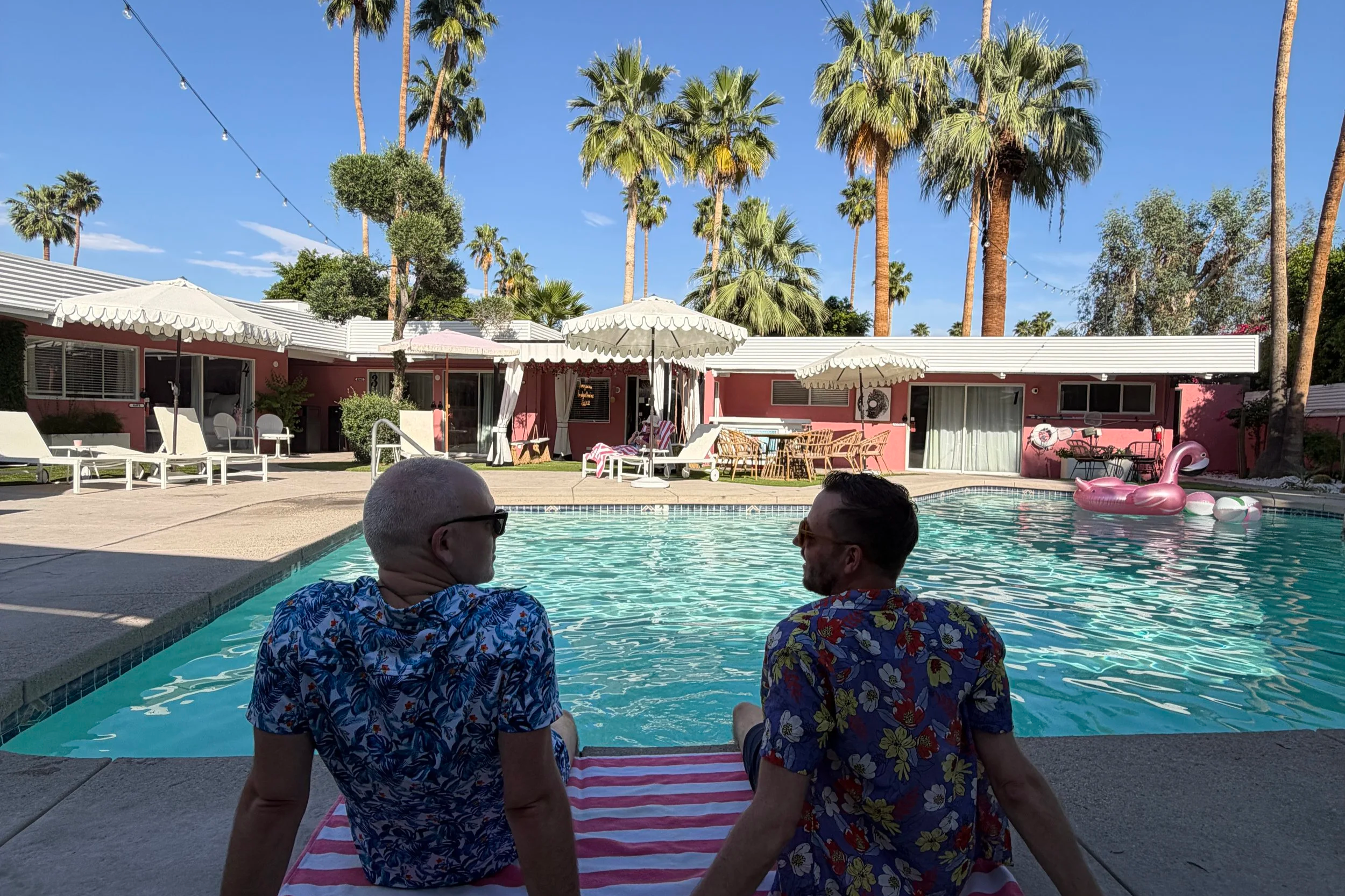
There are cities that hang a rainbow flag during Pride Month, and then there's Palm Springs. The difference is not a matter of degree – it's a matter of identity. In most places, the LGBTQ+ community exists somewhere within the city or concentrated in a neighborhood. In Palm Springs, the LGBTQ+ community largely is the city. And once you've spent even a weekend here, you feel that distinction in a way that's genuinely hard to articulate but impossible to miss. 🌴
For gay men, particularly those navigating a national political climate that has grown increasingly hostile, Palm Springs has become something more than a great vacation. It's become a reference point – a living, breathing reminder of what it feels like to belong somewhere completely, and without asterisks.
Whether you're planning your first gaycation or your fifth return trip, here is our local take on what makes this desert city so singular, so safe, and so joyfully, unapologetically ours.
What makes Palm Springs so safe and welcoming for LGBTQ+ travelers?
Palm Springs, California is widely regarded as the safest and most welcoming LGBTQ+ travel destination in the United States. An estimated 40–50% of its permanent population identifies as LGBTQ+, giving the city the highest queer per-capita concentration of any American city. Palm Springs has a long history of LGBTQ+ representation in local government – including America's first all-LGBTQ+ city council, sworn in in 2017 – and consistently earns a perfect score of 100 on the Human Rights Campaign's Municipal Equality Index. The city is a designated sanctuary for transgender individuals and drag performers, and its police department maintains dedicated LGBTQ+ liaison officers. California's strong statewide protections, combined with Palm Springs' culture of genuine inclusion, make it a uniquely values-aligned destination for gay men seeking safety, community, and an exceptional quality of life.
The Numbers That Tell the Story
Let's start with context, because the numbers here are genuinely remarkable and worth sitting with for a moment.
According to Gallup's most recent data, approximately 7.6% of U.S. adults identify as LGBTQ+. California runs higher than the national average at roughly 8.3%. And Palm Springs conservative estimates put the LGBTQ+ population at somewhere between 40% and 50% of the city's total residents – a statistic worth repeating – with some local estimates suggesting it may be even higher among residents over 18. Gallup's U.S. LGBTQ+ identification research provides the national baseline that makes this contrast so striking.
This is not a "gay neighborhood" in the traditional sense. This is an entire city where queer life is the norm, not the exception. Walk down Palm Canyon Drive or any neighborhood in town – on a Tuesday afternoon and you'll understand the difference almost immediately. Every neighborhood is a gayborhood. Nobody is performing visibility here. It's simply the texture of daily life.
That density of community creates something that's difficult to manufacture and impossible to fake: a city where same-sex couples hold hands at brunch without a second thought, where rainbow flags aren't seasonal décor, and where the phrase "gay-friendly" feels almost quaint in its understatement.
Government That Actually Represents Its People
The safety in Palm Springs isn't accidental, and it didn't happen overnight. It was built – deliberately, incrementally, and with genuine political will – over decades of layered LGBTQ+ history and eventually civic leadership.
The city's history of government representation is remarkable by any standard. In 2004, Ron Oden was elected mayor of Palm Springs, making history as the first openly gay African-American mayor of an American city. In December 2017, Palm Springs made national headlines by swearing in America's first all-LGBTQ+ city council – a milestone that sent a message not just to its residents, but to the entire country. Then in December 2019, Lisa Middleton was sworn in as mayor of Palm Springs, becoming the first openly transgender mayor in California history. The Guardian covered the 2017 milestone in depth, and it remains one of the most cited moments in the city's political legacy.
These aren't footnotes. They are the foundation of why Palm Springs feels the way it does. When your city's leadership reflects who you are, it changes how safe you feel to live there – and how seriously your needs are taken at every level of local government.
That institutional commitment shows up practically as well. The City of Palm Springs consistently earns a perfect score of 100 on the Human Rights Campaign's Municipal Equality Index, which evaluates how inclusive a city's laws, policies, and services are for LGBTQ+ residents. The Palm Springs Police Department maintains active LGBTQ+ Outreach Committee officers and designated community liaisons, building trust between law enforcement and residents in a way that many cities simply haven't prioritized. And in direct response to national legislative attacks, Palm Springs has officially declared itself a sanctuary city for transgender individuals and drag performers seeking healthcare and protection.
What the Rest of the Country Looks Like Right Now
To fully appreciate why Palm Springs resonates so deeply with gay travelers in 2026, it helps to understand what they're often traveling from.
The national picture for LGBTQ+ Americans is, to put it plainly, unsettling. The ACLU tracked over 500 anti-LGBTQ+ bills introduced in state legislatures in a recent reporting year. The Human Rights Campaign declared a formal "National State of Emergency for LGBTQ+ Americans" in response to the unprecedented volume of discriminatory legislation, much of it targeting transgender people in particular. GLAAD's ALERT Desk documented more than 2,600 anti-LGBTQ+ incidents nationwide in a single year – a 26% increase from the year prior, with a significant spike during Pride Month of all times. And a SafeHome.org study found that 54% of LGBTQ+ adults had avoided a public space out of fear of discrimination or violence, with nearly a third actively considering moving to a different state.
These statistics are not abstractions for the people living them. They are the daily context that shapes how gay men move through the world in most of the country – a kind of low-grade hyper-vigilance that, once you've arrived in Palm Springs, you suddenly realize has been with you the whole time. Because here, it lifts noticeably, and almost immediately.
California consistently earns an "A" grade on LGBTQ+ state safety report cards. Palm Springs – even within California – is its own category. The contrast with hostile state climates is so significant that the city has quietly become a destination for what many in the community call "climate refugees": LGBTQ+ individuals and couples relocating from places where the political environment has become untenable. For those with the means to make that move thoughtfully, Palm Springs increasingly represents not just a vacation destination, but a values-aligned place to plant roots.

Explore Homes in Palm Springs
The Social Scene – Where Safety Becomes Belonging
Statistics and government policy create the architecture of safety. What fills it is community – and Palm Springs has built one of the most genuinely connected LGBTQ+ social ecosystems anywhere in the country.
The Arenas District remains the heartbeat of gay nightlife: a concentrated stretch of locally-owned bars, clubs, and restaurants where the LGBTQ+ community gathers with an ease and openness that feels distinctly its own. Hunters Nightclub, Streetbar (the oldest gay bar in the city, open since 1991), Chill Bar, Quadz, and Blackbook each bring their own personality to the district, and bar-hopping between them on a Friday night is one of those experiences that doesn't require any prior planning to become a great memory.
Beyond Arenas, the social culture in Palm Springs extends into nearly every corner of the city. The Warm Sands neighborhood is home to a cluster of men-only clothing-optional resorts – more gay men's resorts per capita than anywhere else on earth – where guests socialize naturally, without judgment, in environments designed for exactly this kind of ease. The gay men's pickleball scene has become its own institution, with multiple organized groups welcoming all skill levels and offering one of the best low-pressure ways to meet locals that we've ever encountered.
Our own monthly Palm Springs Guys Happy Hour Socials rotate across venues throughout the city, and they've become something of a proving ground for what Palm Springs does best: turning strangers into genuine friends with remarkable speed. Visitors and residents mix naturally at these events, and the conversations that start over a cold drink on a patio often continue for years. 👨🏼🤝👨🏻
What distinguishes Palm Springs socially isn't just the volume of LGBTQ+-specific spaces – it's the quality of inclusion embedded in nearly every mainstream space as well. Most restaurants, shops, galleries, and hotels in the city are genuinely, un-performatively welcoming. This is a city where the queer community doesn't cluster in a protected pocket – it's spread throughout, woven into the fabric of ordinary life. That's the "gayborhood effect" at city scale, and there's simply nowhere else quite like it.
The Practical Safety Infrastructure
Palm Springs is safe in ways that are institutionally supported and thoughtfully maintained as well.
DAP Health, formerly known as Desert AIDS Project, has evolved into one of the most comprehensive LGBTQ+ health organizations in the American Southwest. It offers primary and specialty care, behavioral health services, HIV/STI prevention and treatment, and a wide range of community programs – providing a healthcare safety net that matters deeply to LGBTQ+ residents and visitors alike. The LGBTQ Community Center of the Desert complements this with social services, advocacy, and programming that reinforces the city's built-in community infrastructure.
Beyond healthcare, the practical day-to-day experience of being LGBTQ+ in Palm Springs is simply different from most places. Public displays of affection between same-sex couples are not just tolerated – they are entirely unremarkable. You are not an anomaly. You are not the headline. You are just a person enjoying happy hour, which, if you've spent any time in less affirming environments, is a more radical gift than it sounds.
A Gentle Word About the Longer Picture
We want to say this as plainly and gently as we know how: Palm Springs is wonderful to visit. It's even better to live in.
For gay men who find themselves on their second or third trip here, doing the quiet math of what it might mean to stay longer – that instinct is worth listening to. The real estate market here includes mid-century modern gems, architecturally significant properties, and luxury homes that attract buyers who have stopped settling for "fine." The community infrastructure, the climate (300+ days of sunshine annually), and the quality of daily life in Palm Springs are the kinds of things most people only access on vacation – and a growing number are deciding they'd rather have it year-round.
Nobody is pushing you toward any decision. Palm Springs has a way of making its case on its own timeline, which is usually sometime around Day 3 of a really good trip. We've watched it happen more times than we can count. 😎
TL;DR 😜 Why Palm Springs Is the Safest, Most Welcoming LGBTQ+ Destination in America
Palm Springs, California has an estimated 40–50% LGBTQ+ population – the highest per-capita concentration of any American city. That’s a game-changing statistic worth shouting from the rooftops! The city has a history of LGBTQ+ "firsts" in government, including America's first all-LGBTQ+ city council (2017) and California's first transgender mayor (2019). It earns a perfect score of 100 on the Human Rights Campaign's Municipal Equality Index, maintains dedicated LGBTQ+ police liaisons, and has declared sanctuary status for transgender individuals and drag performers. Against a national backdrop of rising anti-LGBTQ+ legislation, hate incidents, and declining acceptance, Palm Springs represents a genuinely singular safe haven – legally protected, culturally affirming, and deeply community-rooted.
FAQ – Palm Springs LGBTQ+ Travel
Is Palm Springs actually safe for gay couples to show public affection?
Absolutely – and in a way that goes well beyond policy. With nearly half the city identifying as LGBTQ+, public affection between same-sex couples is completely ordinary here. Walking hand-in-hand down Palm Canyon Drive, dining in the Uptown Design District, or exploring the Arenas District, you are surrounded by community. Nobody stares. Nobody flinches. That normalcy is the point – and it's one of the most naturally radical things about daily life in Palm Springs.
When is the best time of year to visit Palm Springs as a gay traveler?
The prime season runs from October through May, when desert weather is at its best – sunny days in the 70s and 80s, comfortable evenings, and a full calendar of major LGBTQ+ events. Greater Palm Springs Pride in November draws over 100,000 attendees. February brings Modernism Week, Coachella Music Festival in April – and Summer (June–September) delivers triple-digit heat but also lower rates, pool culture in full swing, and vibrant air-conditioned nightlife for those who know how to work the season.
What makes Palm Springs different from other gay-friendly destinations?
Most "gay-friendly" cities have a neighborhood. Palm Springs has a whole city. The LGBTQ+ community doesn't exist within Palm Springs – it governs it, owns it, built it, and continues to shape it. Between the political representation, the concentration of gay-owned businesses and resorts, the healthcare infrastructure, and the social density, Palm Springs offers a quality of belonging that has no true equivalent anywhere else in the country.
Is Palm Springs a good option for LGBTQ+ individuals considering relocation?
Palm Springs has become a top destination for LGBTQ+ "climate refugees" leaving volatile political and seasonal environments. California's strong state-level protections, combined with the city's community infrastructure – including DAP Health, the LGBTQ Community Center of the Desert, and a deeply integrated queer social fabric – make it one of the most supported places in the country to land. The cost of living is higher than the national average, primarily driven by housing, but generally more accessible than major coastal California cities. For buyers in the $800K+ range, the market here rewards thoughtful timing and local expertise.
Come for the Sunshine. Stay for the Belonging.
Gay Palm Springs is not a trend. It is not a moment. It is a decades-long, community-built, politically-backed, architecturally-framed argument for what it looks like when a city genuinely values its LGBTQ+ residents – and visitors who arrive here for the first time tend to feel that argument land in their bones before they can articulate it.
The weather alone is worth the trip: October through May delivers near-perfect desert conditions, with warm sunny days, cool to warm evenings, and the kind of blue sky that makes everything feel more possible. Summers run hot, but they come with their own pleasures – private resort days, low season rates, and a city that briefly gives itself back to those who know it best.
More than the weather, more than the mid-century modern architecture, more than the steadfast gay nightlife and the resorts and the extraordinary restaurant scene – what gay men consistently report after their first trip to Palm Springs is how easy it was to make friends here. How quickly a conversation at a pool bar became an actual connection. How natural it felt to walk into a room and belong. That social ease is not a coincidence. It is the direct product of a community that has been building this place, with intention and love, for a very long time.
And for those who find themselves wondering, somewhere around day three, whether a place like this could actually become home – welcome to the beginning of a very energizing conversation. 🏳️🌈
Question for you: With so much happening politically across the country right now, how has it changed the way you choose where to travel or where to plant roots?
For related reading, check out these articles from The Palm Springs Guys blog:
How Palm Springs Became the Safest LGBTQ+ Place in America – the deeper history behind the city's safety record.
Curious About Moving to Gay Palm Springs? What We Hear Most – the honest, locals-only answers to the questions that come up around Day 3 of every great trip.
How Gay Men Actually Spend a Week in Palm Springs (Not the Brochure Version) – where the safety and community described in this article shows up in practice, day by day.
Palm Springs: What's Iconic, What's Changed, and What Still Matters – a broader look at the city's evolution and why the LGBTQ+ community remains at its core.
5 Things We Always Tell Gay Friends Visiting Palm Springs for the First Time – essential reading before you pack.

Thinking About Buying, Selling, or Relocating to Palm Springs?
Glen Nadeau – one half of The Palm Springs Guys – is a top-producing Palm Springs Realtor known for his no-pressure, highly informed approach.
If you’re just starting to explore or simply have questions, you’re always welcome to reach out.
👉 Visit Modern Living Palm Springs or contact Glen directly.
📱 Call/Text: 805-220-8097 | ✉️ glen.nadeau@compass.com
